
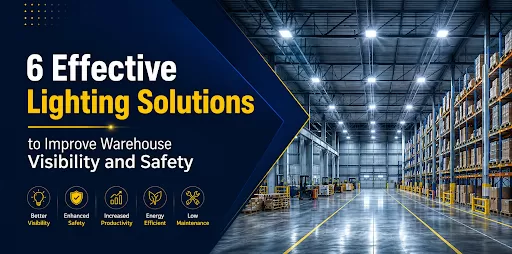
Warehouses are designed to move goods efficiently, manage inventory accurately, and support continuous operations. Yet one factor that significantly affects performance across all these areas is often underestimated—lighting.
Poor visibility can impact worker safety, slow operational processes, increase picking errors, and create unnecessary maintenance challenges. As warehouses become larger, more automated, and increasingly active around the clock, lighting has evolved from a facility utility into an important operational investment.
Modern warehouse lighting solutions are designed to improve visibility, support safer movement, enhance productivity, and reduce long-term operating costs.
Below are six effective lighting solutions businesses should consider to create safer and more efficient warehouse environments.
1. High Bay LED Lighting for Large Warehouse Spaces
High bay lighting remains one of the most effective solutions for warehouses with elevated ceilings and expansive floor areas.
These systems are designed to provide broad and uniform illumination across operational zones while maintaining energy efficiency.
Benefits:
- Improved visibility across large spaces
- Better aisle illumination
- Reduced shadow formation
- Lower energy consumption
- Long-term operational reliability
High bay lighting is particularly effective in distribution centers, fulfillment facilities, and industrial storage environments.
2. Linear Lighting for Warehouse Aisles
Warehouse aisles require lighting that supports accurate inventory handling and comfortable navigation.
Linear lighting systems help deliver continuous and balanced illumination throughout storage zones.
Benefits:
- Enhanced visibility between racks
- Improved picking accuracy
- Comfortable visual conditions
- Consistent light distribution
This solution works especially well in facilities with organized shelving and repetitive operational workflows.
3. LED Flood Lighting for Loading and Outdoor Areas
Warehouse operations often extend beyond indoor spaces.
Loading docks, vehicle movement zones, access roads, and outdoor storage areas require dependable illumination to maintain operational continuity.
Benefits:
- Improved outdoor visibility
- Enhanced site safety
- Better loading and unloading conditions
- Reliable performance in demanding environments
Outdoor lighting helps support smooth logistics operations throughout the facility.
4. Motion and Zone-Based Lighting Controls
Modern warehouses increasingly focus on intelligent energy usage. Lighting controls can help optimize illumination by activating only when and where required.
Benefits:
- Reduced energy consumption
- Extended lighting lifespan
- Lower operational costs
- Improved lighting efficiency
This approach can be particularly useful in areas with varying occupancy levels.
5. Task Lighting for Inspection and Packing Areas
Certain warehouse operations require greater visual precision than general facility lighting can provide. Inspection stations, packing zones, and quality control areas often benefit from dedicated task lighting.
Benefits:
- Improved operational accuracy
- Better visual clarity
- Reduced employee fatigue
- Higher process consistency
Focused lighting can significantly improve detailed operational tasks.
6. Integrated Warehouse Lighting Design
One of the most overlooked solutions is not a fixture—but a complete lighting strategy. Warehouses often perform better when multiple lighting approaches work together to support different operational zones.
An integrated approach considers:
- Ceiling height
- Rack configuration
- Traffic flow
- Operating schedules
- Maintenance access
- Employee comfort
This creates more balanced environments that support both efficiency and safety.
How Better Lighting Improves Warehouse Safety
Lighting plays a direct role in workplace safety.
Effective warehouse lighting can help:
- Improve movement visibility
- Reduce accidents and collisions
- Enhance forklift operation
- Improve hazard identification
- Support emergency response visibility
Creating safer environments often begins with creating better visibility.
Common Mistakes Businesses Should Avoid
Many warehouse lighting projects underperform not because of product limitations, but because of planning decisions made too early in the selection process. A well-designed lighting strategy should support how the warehouse operates on a daily basis rather than applying a one-size-fits-all approach.
Some of the most common mistakes include:
Prioritizing Cost Over Performance
Selecting lighting based only on upfront investment can lead to higher maintenance requirements, reduced efficiency, and increased operational costs over time. Long-term performance should always be considered alongside initial cost.
Using the Same Lighting Across All Operational Zones
Different warehouse areas serve different purposes. Storage aisles, loading bays, packing stations, and circulation areas often require different lighting approaches to achieve optimal visibility and efficiency.
Ignoring Maintenance Accessibility
Warehouses often have high ceilings and continuous operations, making maintenance more complex. Choosing lighting systems without considering accessibility can increase servicing time and operational interruptions.
Underestimating Long-Term Ownership Costs
The actual value of a lighting system extends beyond installation. Energy consumption, maintenance frequency, product lifespan, and reliability all influence total ownership costs over time.
Focusing Only on Brightness Instead of Visibility
Higher brightness does not automatically create better working conditions. Effective warehouse lighting should provide balanced illumination, reduce shadows, and support comfortable visibility across operational areas.
A successful warehouse lighting strategy should be designed around operational requirements, employee safety, and long-term efficiency to help the facility perform consistently over time.
Conclusion: Build Safer and More Efficient Warehouses With the Right Lighting
Warehouse performance depends on more than inventory systems and operational planning. Visibility influences how efficiently people move, how safely tasks are performed, and how effectively facilities operate every day.
The most effective warehouse lighting solutions combine uniform illumination, energy efficiency, long-term reliability, and application-focused design to support both operational performance and employee experience.
At Tucana Lights, we believe lighting should do more than illuminate a facility—it should help businesses create safer, more productive, and more efficient environments. As a research and design-driven lighting manufacturer, we develop lighting solutions engineered for demanding industrial and warehouse applications where performance, reliability, and long-term value matter.
Whether upgrading an existing warehouse or planning a new facility, investing in the right lighting strategy today can create measurable operational benefits for years to come.