
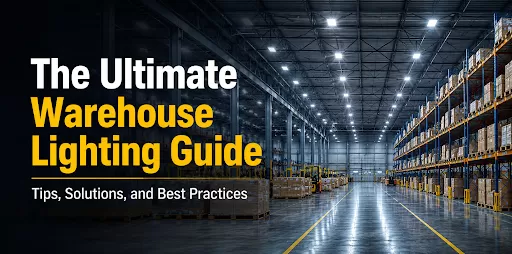
Warehouses have evolved far beyond simple storage spaces. Modern facilities now operate as distribution hubs, fulfillment centers, inventory management systems, and critical components of global supply chains. As these environments become more active and performance-driven, lighting plays an increasingly important role in supporting daily operations.
Industrial warehouse lighting directly influences visibility, employee safety, operational efficiency, inventory accuracy, maintenance planning, and long-term operating costs.
A well-planned lighting strategy does more than illuminate a building—it helps warehouses function more effectively.
This guide explores how warehouse lighting works, why it matters, and the best practices businesses should consider when designing or upgrading warehouse environments.
Why Warehouse Lighting Matters
Lighting affects nearly every activity taking place inside a warehouse. Employees depend on visibility to move safely, identify inventory, operate equipment, perform inspections, and complete tasks accurately.
Poor lighting can contribute to:
- Reduced operational efficiency
- Lower picking accuracy
- Employee discomfort
- Safety risks
- Higher maintenance costs
- Increased energy consumption
On the other hand, a properly designed lighting system helps create an environment that supports both operational performance and workplace experience.
Understanding Industrial Warehouse Lighting
Industrial warehouse lighting refers to lighting systems specifically designed for large storage and operational environments. Unlike general commercial lighting, warehouse facilities often require solutions capable of handling:
- High ceilings
- Wide floor areas
- Continuous operations
- Material movement
- Multiple operational zones
- Long operating schedules
Effective lighting must support visibility while remaining reliable and efficient over time.
Key Objectives of Effective Warehouse Lighting
A successful warehouse lighting strategy should focus on more than achieving higher brightness levels. The goal is to create an environment that supports operational performance, employee experience, and long-term efficiency.
Improve Visibility
Clear and balanced illumination helps employees move safely, identify inventory accurately, operate equipment efficiently, and perform day-to-day tasks with greater confidence.
Support Workplace Safety
Well-lit warehouse environments improve awareness across aisles, storage areas, loading zones, and movement paths, helping reduce operational risks and supporting safer working conditions.
Increase Productivity
Comfortable and consistent lighting minimizes visual fatigue and helps employees maintain focus, contributing to smoother workflows and improved operational efficiency.
Reduce Operating Costs
Energy-efficient lighting systems help lower electricity consumption while reducing maintenance requirements and supporting better long-term facility performance.
Improve Long-Term Reliability
Durable lighting solutions designed for demanding warehouse environments help minimize disruptions, extend service life, and maintain consistent illumination over time. The most effective warehouse lighting strategies balance visibility, safety, efficiency, and reliability to support both current operations and future business needs.
Common Types of Warehouse Lighting Solutions
Different warehouse environments require different approaches.
High Bay LED Lighting
High bay lighting is one of the most commonly used solutions for warehouse facilities with elevated ceilings.
Best suited for:
- Distribution centers
- Industrial warehouses
- Storage facilities
- Logistics hubs
Advantages:
- Broad illumination coverage
- Improved visibility
- Long operational life
- Lower maintenance requirements
Linear Lighting Systems
Linear fixtures provide consistent illumination throughout warehouse aisles and operational zones.
Best suited for:
- Storage aisles
- Inventory zones
- Picking operations
Advantages:
- Uniform illumination
- Reduced shadowing
- Comfortable working environments
LED Flood Lighting
Flood lighting supports external warehouse operations.
Best suited for:
- Loading docks
- Vehicle movement zones
- Outdoor storage areas
Advantages:
- Wide area illumination
- Improved site safety
- Reliable outdoor performance
Task Lighting
Some warehouse operations require more focused illumination.
Best suited for:
- Packing stations
- Inspection areas
- Equipment maintenance
Advantages:
- Enhanced visibility
- Better operational precision
Tips for Choosing the Right Warehouse Lighting
Selecting warehouse lighting requires evaluating operational requirements rather than comparing specifications alone.
Understand Operational Zones
Different activities require different lighting strategies. Receiving areas, storage racks, loading bays, and packing stations may all require unique lighting approaches.
Evaluate Ceiling Height
Mounting height directly affects lighting performance and fixture selection. Lighting should deliver balanced illumination without creating excessive brightness or dark areas.
Focus on Uniform Illumination
Uneven lighting can reduce visibility and create discomfort. Balanced light distribution supports safer and more efficient operations.
Consider Operating Hours
Warehouses with long operating schedules benefit from lighting systems designed for reliable continuous performance.
Think Beyond Installation Cost
Evaluate:
- Energy usage
- Maintenance requirements
- Product lifespan
- Operational continuity
- Ownership value
Long-term performance often creates greater business value.
Best Practices for Industrial Warehouse Lighting
Modern warehouse lighting strategies increasingly follow practical design principles.
Design Around Workflow
Lighting should support how employees move and perform tasks.
Reduce Visual Fatigue
Comfortable lighting environments help improve focus during extended work periods.
Prioritize Maintenance Efficiency
Lighting systems should minimize operational disruptions during servicing.
Support Sustainability Goals
Energy-efficient lighting contributes to broader environmental and operational initiatives.
Create Flexible Lighting Environments
Warehouses evolve over time. Lighting infrastructure should support future operational changes.
Common Warehouse Lighting Mistakes to Avoid
Even well-planned warehouse projects can experience performance challenges if lighting decisions are made without considering actual operational requirements. A warehouse lighting strategy should support how the facility functions every day—not simply provide illumination.
Avoid these common mistakes:
Selecting Products Based Only on Price
Choosing lighting solely based on initial cost can lead to reduced efficiency, higher maintenance requirements, and increased ownership costs over time. Long-term performance should always be considered alongside budget.
Using Identical Lighting Throughout the Facility
Different warehouse zones serve different purposes. Storage areas, loading docks, inspection stations, and circulation zones often require different lighting approaches to achieve optimal visibility and efficiency.
Ignoring Maintenance Accessibility
Warehouses frequently operate with elevated ceilings and continuous activity. Selecting lighting without considering servicing access can increase maintenance effort and operational disruptions.
Overlooking Future Operational Requirements
Facilities evolve over time. Lighting systems should be flexible enough to support future layout changes, expanded operations, and evolving business needs.
Prioritizing Brightness Over Visibility
More brightness does not necessarily create better working conditions. Effective lighting should improve visibility, reduce shadows, and maintain comfortable viewing conditions across operational areas.
Underestimating Lifecycle Costs
Lighting decisions should consider installation, maintenance, energy consumption, reliability, and long-term operational value—not only upfront investment. A thoughtful warehouse lighting strategy often delivers stronger long-term performance, lower operational disruption, and a better working environment.
Questions to Ask Before Upgrading Warehouse Lighting
Before selecting a warehouse lighting solution, businesses should evaluate both current operations and future requirements.
What activities occur within the facility?
Different operational functions require different illumination levels and lighting approaches.
How many hours does the warehouse operate?
Long operating schedules influence energy consumption, reliability requirements, and maintenance planning.
Are there multiple operational zones?
Storage areas, loading bays, dispatch sections, and inspection zones may all require different lighting conditions.
What maintenance access is available?
Facilities with high ceilings and limited servicing access benefit from long-life, low-maintenance lighting systems.
Will the facility expand in the future?
Lighting infrastructure should support future operational growth and changing facility layouts.
What business goals should lighting support?
Lighting should contribute to broader objectives such as productivity, safety, efficiency, employee experience, and operational continuity. These questions help businesses make more informed decisions and create lighting environments that remain effective over time.
The Future of Warehouse Lighting
Warehouse operations continue to evolve through automation, higher performance expectations, and changing infrastructure requirements. Modern lighting systems are expected to support this evolution through:
Greater Efficiency
Delivering high-performance illumination while reducing energy consumption.
Improved Reliability
Providing dependable operation under demanding industrial conditions.
Better User Comfort
Creating environments that support visibility and reduce visual fatigue.
Smarter Operational Support
Adapting to changing workflows and improving facility performance.
Long-Term Adaptability
Supporting future expansion, modernization, and operational growth.
Businesses increasingly view warehouse lighting as part of critical operational infrastructure rather than simply a facility expense.
Conclusion
Warehouse lighting influences much more than visibility. It affects employee safety, operational efficiency, inventory accuracy, maintenance planning, and the overall performance of the facility.
The most effective industrial warehouse lighting strategies combine application-focused design, reliable operation, energy efficiency, and long-term value to create environments that perform consistently over time.
At Tucana Lights, we believe lighting should contribute to how warehouses operate—not just how they look. As a research and design-driven lighting manufacturer, we develop high-performance lighting solutions engineered to support demanding industrial environments with a focus on reliability, efficiency, and long-term operational performance.
Whether planning a new warehouse facility or upgrading an existing one, investing in the right lighting strategy today can help build safer, more productive, and future-ready warehouse operations for tomorrow.