
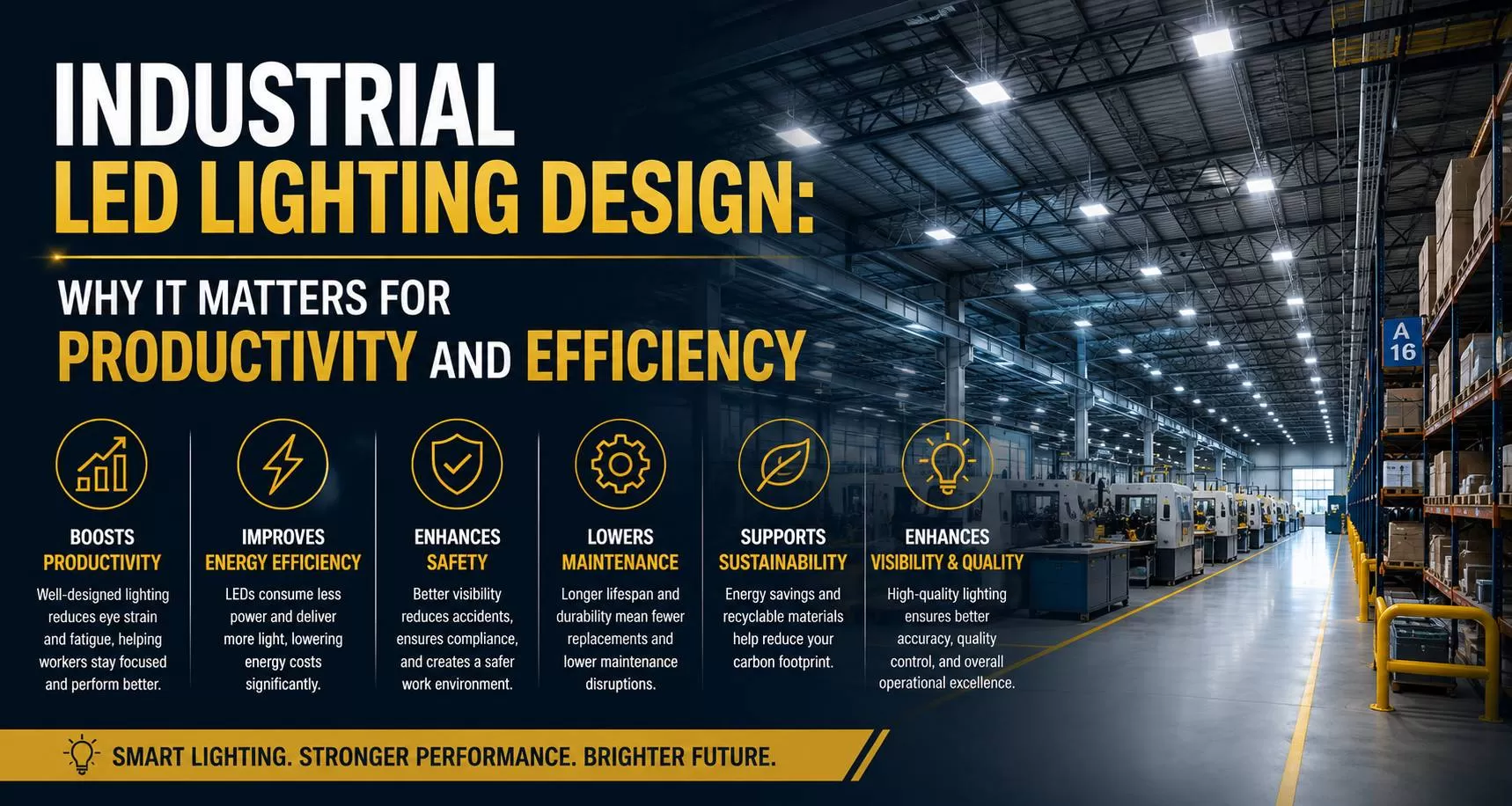
Industrial facilities are becoming more demanding. Manufacturing floors, warehouses, workshops, and production areas often operate for long hours, handle complex processes, and require employees to work safely around machinery and moving equipment.
In these environments, lighting is not simply a matter of illuminating the floor. The quality, distribution, reliability, and efficiency of the lighting system can influence how comfortably and accurately people work.
A well-designed industrial LED lighting system can improve visibility, support workplace safety, reduce energy consumption, and contribute to more efficient facility operations.
What Is Industrial LED Lighting Design?
Industrial LED lighting design is the process of planning lighting around the specific requirements of an industrial environment.
It considers factors such as:
Ceiling height
Facility layout
Type of work performed
Operating hours
Machinery and equipment
Storage and movement areas
Required visibility
Maintenance accessibility
Energy consumption
Rather than placing fixtures at regular intervals, effective design aims to deliver the right illumination where it is needed while avoiding excessive brightness, glare, shadows, and unnecessary energy use.
Why Lighting Design Matters in Industrial Facilities
Industrial spaces can vary considerably from one area to another. A production floor may require broad, uniform illumination, while an inspection station may need more focused lighting.
A properly designed system helps address these differences.
1. Better Visibility Supports Productivity
Employees need clear visibility to operate machinery, identify materials, read labels, inspect products, and perform detailed tasks.
Poorly distributed lighting can create shadows or dark areas that make routine activities more difficult.
Consistent illumination helps employees work with greater confidence and can support smoother day-to-day workflows.
2. High-Quality Lighting Supports Workplace Safety
Industrial facilities often contain machinery, vehicles, tools, elevated structures, and active movement zones.
Good visibility helps employees identify potential hazards and navigate the facility more confidently.
Lighting should therefore be considered as one component of a broader workplace safety strategy.
3. Industrial High Bay LED Lights for High-Ceiling Areas
For factories and warehouses with high mounting heights, industrial high bay LED lights can provide an effective way to illuminate large areas from elevated positions.
They are commonly considered for:
Manufacturing floors
Warehouses
Industrial sheds
Distribution facilities
Large workshops
Production halls
However, selecting high bay fixtures should not be based on wattage alone. Mounting height, beam distribution, spacing, ceiling structure, operating conditions, and the activities performed below the fixtures all influence the final result.
4. Better Lighting Can Reduce Energy Consumption
Industrial facilities may operate lighting for many hours every day. Consequently, lighting efficiency can have a meaningful impact on operating expenses.
LED technology offers an opportunity to reduce energy consumption compared with older lighting technologies while providing long operating life.
However, energy savings depend on the complete system—not simply the LED fixture. Appropriate lighting levels, fixture placement, controls, and operating schedules should all be considered.
5. Visual Comfort Matters During Long Shifts
Industrial employees may spend several hours working under artificial lighting. Excessive glare, harsh contrasts, or poorly distributed illumination can make the environment uncomfortable.
Effective lighting design should consider:
Glare
Uniformity
Contrast
Shadowing
Viewing angles
Workstation requirements
The objective is to create lighting that supports comfortable visibility rather than simply maximizing brightness.
Different Areas Require Different Lighting Strategies
A common mistake is using the same lighting approach throughout an entire industrial facility.
Production Areas
Production floors generally require consistent illumination across machinery, workstations, and movement paths.
Storage Areas
Warehouse and storage zones need sufficient visibility across aisles, racks, and material handling areas.
Inspection Areas
Quality control and inspection stations may require more focused illumination to help employees identify small defects or variations.
Loading Areas
Loading docks and vehicle movement zones require lighting that supports safe movement of people, vehicles, and materials.
Offices and Support Areas
Administrative areas within industrial facilities may require a different approach focused on visual comfort and screen-based work.
A zone-based lighting strategy can therefore provide better results than a one-size-fits-all system.
How to Design a More Efficient Industrial Lighting System
Before selecting fixtures, businesses should understand how the facility operates.
Assess the Facility Layout
Identify production zones, storage areas, aisles, workstations, loading areas, and other operational spaces.
Measure Mounting Heights
Fixture selection and light distribution depend heavily on mounting height.
Understand the Work Being Performed
Detailed manufacturing or inspection tasks may have different lighting requirements from general storage activities.
Consider Operating Hours
Facilities operating continuously or for extended shifts should prioritize efficiency, reliability, and maintenance planning.
Evaluate Maintenance Access
High-mounted fixtures can be difficult and costly to service. Long-life lighting solutions can help reduce maintenance interruptions.
Plan for Future Changes
Factory layouts can change as production processes evolve. Lighting infrastructure should ideally accommodate future modifications and expansion.
Common Industrial Lighting Design Mistakes
Even high-quality lighting products can produce disappointing results when the overall design is poorly planned.
Common mistakes include:
Selecting fixtures based only on price
Focusing on wattage instead of actual lighting performance
Installing excessive lighting where it is not required
Ignoring glare and shadowing
Using identical fixtures throughout different operational zones
Overlooking maintenance access
Failing to consider future facility changes
Good lighting design starts with understanding the environment before selecting the products.
Why Industrial LED Lighting Should Be Viewed as Infrastructure
Lighting is often treated as a simple operating expense, but in an industrial facility it supports everyday activities across the building.
A reliable lighting system can contribute to:
Safer movement
Better visibility
More comfortable working conditions
Efficient operations
Lower energy consumption
Reduced maintenance disruption
This makes lighting an important part of facility infrastructure rather than simply a collection of fixtures installed on the ceiling.
Conclusion
Industrial LED lighting design matters because lighting directly interacts with people, processes, equipment, and the physical environment. The right system can support productivity and safety while helping businesses manage energy consumption and long-term maintenance requirements.
Industrial high bay LED lights can be particularly effective for high-ceiling factories, warehouses, and large industrial spaces, but their performance depends on appropriate planning, placement, distribution, and application.
At Tucana Lights, our approach to industrial lighting is research and design driven. We develop high-performance lighting solutions for demanding environments where reliability, efficiency, appearance, and long-term performance all matter.
By treating lighting as part of the facility's operational infrastructure—and designing it around actual business requirements—industrial organizations can create safer, more efficient, and better-performing workplaces.