
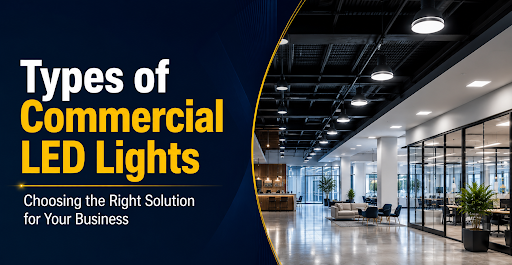
Choosing the right commercial LED lights is an important decision for any business. Lighting affects visibility, safety, productivity, energy consumption, customer experience, and the overall appearance of a space.
A factory, warehouse, showroom, office, indoor stadium, and commercial building cannot use the same lighting approach. Each environment has different ceiling heights, working conditions, lux requirements, operating hours, and design expectations.
That is why businesses need to understand the different types of commercial LED lights before selecting a solution.
This guide explains the major types of commercial LED lights, where they are used, how they differ, and how to choose the right lighting solution for your business.
What Are Commercial LED Lights?
Commercial LED lights are lighting systems designed for business, industrial, retail, institutional, architectural, and public-use spaces. They are built to deliver strong illumination, long operating life, better energy efficiency, and dependable performance in spaces that are used for long hours.
Commercial LED lighting is commonly used in:
- Factories
- Warehouses
- Offices
- Showrooms
- Retail stores
- Shopping malls
- Indoor stadiums
- Auditoriums
- Convention centers
- Institutions
- Parking areas
- Industrial campuses
- Logistics facilities
- Architectural spaces
Unlike basic residential lighting, commercial LED lights are designed for higher performance, better durability, and more demanding usage conditions.
For businesses planning a new facility or upgrading existing lights, choosing the right commercial led lighting solution can improve operational efficiency, reduce maintenance, and create a better environment for people using the space.
Why Choosing the Right Commercial LED Light Matters
Many businesses make the mistake of selecting lights only by wattage or price. However, commercial lighting should be selected based on application, height, light distribution, beam angle, glare control, operating hours, thermal performance, and long-term value.
The right commercial LED lighting can help improve:
- Workplace visibility
- Employee productivity
- Operational safety
- Customer experience
- Energy efficiency
- Product presentation
- Visual comfort
- Long-term maintenance cost
- Overall space appearance
Poor lighting can create glare, dark spots, uneven brightness, eye strain, safety risks, and higher electricity bills.
This is why businesses should understand the available lighting types before finalizing the right solution.
Major Types of Commercial LED Lights
Different commercial environments require different lighting systems. Below are the most common types of commercial LED lights used across industrial, commercial, architectural, and specialized spaces.
1. LED High Bay Lights
LED high bay lights are used in spaces with high ceilings. They are designed to provide powerful illumination from greater heights and are commonly used in industrial and commercial environments.
These lights are ideal for spaces where standard lights cannot provide enough brightness or uniform coverage.
Best Used For:
- Factories
- Warehouses
- Manufacturing units
- Industrial sheds
- Godowns
- Logistics centers
- Indoor stadiums
- Large workshops
- Production floors
Why Businesses Choose LED High Bay Lights
LED high bay lights provide strong illumination over large areas. They help improve visibility for workers, machines, storage zones, movement areas, and production lines.
They are especially useful in spaces where lights are mounted at a height and need to deliver consistent brightness across the floor.
Selection Tips
Choose LED high bay lights based on:
- Ceiling height
- Required lux level
- Beam angle
- Mounting pattern
- Area size
- Heat management
- Maintenance access
- Operating hours
For high-ceiling industrial spaces, high bay lights should be selected carefully because incorrect beam angles can create uneven lighting or glare.
Businesses can explore Highfin Light or Heat Tube Cooled Highbay Lights for demanding industrial and high-ceiling applications.
2. LED Linear Lights
LED linear lights are long, sleek lighting fixtures designed to provide clean and uniform illumination. They are suitable for spaces that require continuous light distribution and a modern visual appearance.
Linear LED lights are widely used in offices, classrooms, factories, retail areas, commercial interiors, and workspaces.
Best Used For:
- Offices
- Classrooms
- Workstations
- Retail stores
- Commercial interiors
- Warehouses
- Printing areas
- Factories
- Stations
- Institutional spaces
Why Businesses Choose LED Linear Lights
LED linear lights offer a clean and organized look while providing practical illumination. They are suitable for spaces where both design and performance matter.
They can be used in rows for uniform light distribution and are especially useful in long spaces, work areas, corridors, and commercial interiors.
Selection Tips
Choose LED linear lights based on:
- Length of the space
- Ceiling type
- Desired brightness
- Light spread
- Installation style
- Design requirement
- Glare control
- Color temperature
For businesses that need functional and visually refined lighting, Beamstream Series Lights can be considered for commercial, industrial, retail, and workplace applications.
3. LED Bay Lights
LED bay lights are suspended lighting fixtures used in commercial, industrial, and architectural spaces. They are designed to deliver practical illumination while also improving the visual appearance of the space.
Bay lights are useful where lighting needs to be functional but also visually appealing.
Best Used For:
- Showrooms
- Offices
- Commercial interiors
- Architectural spaces
- Retail spaces
- Industrial workspaces
- Public buildings
- Hospitality spaces
Why Businesses Choose LED Bay Lights
LED bay lights are suitable for businesses that want lighting fixtures that look refined while delivering strong performance. They can enhance the atmosphere of a space without compromising visibility.
They are often used in areas where the light fixture itself becomes part of the design language.
Selection Tips
Choose LED bay lights based on:
- Interior design style
- Ceiling height
- Beam spread
- Fixture shape
- Color finish
- Required brightness
- Application area
- Mounting arrangement
Businesses looking for suspended commercial lighting solutions can explore Bay Light.
4. LED Parabolic Lights
LED parabolic lights are designed for spaces where lighting performance and aesthetics need to work together. They are especially useful in architectural and premium commercial environments.
These lights provide directional or decorative illumination while maintaining functional brightness.
Best Used For:
- Architectural spaces
- Premium showrooms
- Commercial lobbies
- Hospitality spaces
- Retail interiors
- Public buildings
- Design-led commercial areas
- Decorative commercial lighting applications
Why Businesses Choose LED Parabolic Lights
Parabolic lights help create a unique visual identity for a space. They are suitable for businesses that want lighting to enhance ambience, design, and user experience.
In commercial environments, lighting is not always only about brightness. Sometimes, the fixture design, light direction, and atmosphere are equally important.
Selection Tips
Choose LED parabolic lights based on:
- Space design
- Directional lighting requirement
- Mounting type
- Visual impact
- Color options
- Beam direction
- Application purpose
For modern architectural and design-focused commercial spaces, businesses can explore Parabolic Lights.
5. LED Flood Lights
LED flood lights are high-output lights designed to illuminate large outdoor or semi-outdoor areas. They are commonly used for commercial exteriors, parking areas, stadiums, industrial yards, security areas, and infrastructure projects.
Flood lights are built to provide wide and powerful illumination.
Best Used For:
- Parking areas
- Commercial exteriors
- Industrial campuses
- Outdoor storage yards
- Logistics hubs
- Building facades
- Sports grounds
- Security lighting
- Infrastructure spaces
Why Businesses Choose LED Flood Lights
LED flood lights help improve outdoor visibility and safety. They are useful for businesses that need powerful lighting for movement, security, vehicle areas, loading zones, and open spaces.
Outdoor lighting should be durable, energy-efficient, and suitable for long operating hours.
Selection Tips
Choose LED flood lights based on:
- Outdoor area size
- Mounting height
- Beam spread
- Weather exposure
- Required brightness
- Security needs
- Energy efficiency
- Installation position
Businesses should also consider glare control and light direction when using flood lights in public or commercial areas.
6. LED Panel Lights
LED panel lights are flat lighting fixtures commonly used in offices, commercial buildings, institutions, hospitals, and retail spaces. They provide soft, uniform illumination and are often installed in false ceilings.
Panel lights are suitable for spaces where clean appearance and comfortable indoor lighting are important.
Best Used For:
- Offices
- Meeting rooms
- Hospitals
- Schools
- Retail stores
- Reception areas
- Commercial buildings
- Banks
- Clinics
Why Businesses Choose LED Panel Lights
LED panel lights create a neat and professional look. They distribute light evenly and are suitable for spaces where people work for long hours.
They are usually preferred in indoor commercial areas that need comfortable brightness without a heavy industrial look.
Selection Tips
Choose LED panel lights based on:
- Ceiling type
- Panel size
- Color temperature
- Brightness level
- Glare control
- Room size
- Working hours
For offices and commercial interiors, panel lights should be selected with visual comfort in mind.
7. LED Downlights
LED downlights are compact lights installed into ceilings to provide focused or general illumination. They are commonly used in showrooms, offices, hotels, retail stores, corridors, and commercial interiors.
Downlights offer a clean ceiling appearance and can be used for both functional and accent lighting.
Best Used For:
- Showrooms
- Retail stores
- Offices
- Hotels
- Restaurants
- Corridors
- Reception areas
- Commercial interiors
Why Businesses Choose LED Downlights
LED downlights are useful when the business wants a clean, modern, and minimal lighting design. They can be used to highlight products, create zones, or provide general room lighting.
In showrooms and retail spaces, downlights help improve product visibility and customer experience.
Selection Tips
Choose LED downlights based on:
- Ceiling height
- Beam angle
- Color temperature
- Product display needs
- Spacing
- Glare control
- Trim design
Downlights should be planned carefully because poor placement can create uneven brightness or harsh shadows.
8. LED Track Lights
LED track lights are adjustable lighting fixtures mounted on a track system. They are commonly used in showrooms, retail stores, galleries, studios, and display-focused commercial spaces.
Track lighting allows flexible direction of light, making it useful for highlighting products or specific areas.
Best Used For:
- Retail stores
- Garment showrooms
- Furniture showrooms
- Marble studios
- Art galleries
- Product display areas
- Studios
- Premium commercial interiors
Why Businesses Choose LED Track Lights
LED track lights allow businesses to direct light where it is needed. If a showroom layout changes, the lighting direction can often be adjusted without major electrical changes.
They are especially useful for display spaces where product focus matters.
Selection Tips
Choose LED track lights based on:
- Product display type
- Beam angle
- Color rendering
- Track layout
- Fixture adjustability
- Ceiling height
- Desired ambience
Businesses with showroom spaces can explore Showroom Lights to understand application-based lighting solutions.
9. LED Tube Lights
LED tube lights are commonly used as replacements for traditional fluorescent tube lights. They are suitable for general commercial lighting in offices, workshops, parking areas, back-end spaces, and utility areas.
They are simple, practical, and widely used in many commercial environments.
Best Used For:
- Offices
- Workshops
- Parking areas
- Utility rooms
- Corridors
- Storage areas
- Back-office spaces
- Small commercial units
Why Businesses Choose LED Tube Lights
LED tube lights are easy to install and provide better energy efficiency compared to many older lighting systems. They are often used in areas where basic functional lighting is required.
Selection Tips
Choose LED tube lights based on:
- Length
- Wattage
- Lumens
- Color temperature
- Fixture compatibility
- Installation type
For large or high-performance spaces, businesses should avoid relying only on tube lights and consider application-specific commercial LED lighting instead.
10. LED Street and Area Lights
LED street and area lights are used for outdoor business spaces, pathways, campuses, parking zones, roads, and industrial areas. They are designed to improve outdoor visibility and security.
Best Used For:
- Commercial campuses
- Industrial roads
- Parking areas
- Pathways
- Outdoor movement zones
- Logistics facilities
- Building surroundings
Why Businesses Choose LED Street and Area Lights
These lights improve outdoor safety and movement. They are important for businesses that operate in large outdoor spaces or require nighttime visibility.
Selection Tips
Choose LED street and area lights based on:
- Pole height
- Road or pathway width
- Area coverage
- Required brightness
- Weather resistance
- Energy efficiency
- Maintenance access
Good outdoor lighting should provide visibility without creating unnecessary glare or light wastage.
How to Choose the Right Commercial LED Lighting Solution
The best lighting solution depends on the space, application, and expected performance. Below are the most important factors businesses should consider.
1. Understand the Application
The first step is to understand how the space is used.
A factory needs lighting for productivity, safety, and machine operation. A showroom needs lighting for product presentation. A warehouse needs uniform illumination for movement and inventory handling. An office needs visual comfort for long working hours.
Before choosing lights, ask:
- What activity happens in the space?
- Is the space used for work, display, movement, storage, or public use?
- How many hours will the lights operate daily?
- Are there safety or inspection requirements?
- Does the space need functional lighting, decorative lighting, or both?
The lighting solution should match the purpose of the space.
2. Check Ceiling Height
Ceiling height plays a major role in lighting selection.
High-ceiling spaces usually require LED high bay lights or specialized industrial fixtures. Medium-height spaces may use bay lights, linear lights, or suspended fixtures. Lower ceilings may use panel lights, downlights, or linear lighting.
If the light is not suitable for the ceiling height, the space may become too dark, too bright, or unevenly lit.
3. Decide the Required Lux Level
Lux refers to the amount of light that reaches a surface. Different spaces need different lux levels.
For example:
- Warehouses need uniform light for movement and storage
- Factories need stronger light for production and inspection
- Offices need comfortable light for screen and desk work
- Showrooms need lighting that improves product visibility
- Sports facilities need high uniformity and visual comfort
A proper lighting plan should consider lux requirements before product selection.
4. Choose the Right Beam Angle
Beam angle determines how light spreads from the fixture.
A narrow beam focuses light in a smaller area. A wide beam spreads light across a larger area. The right beam angle depends on ceiling height, fixture spacing, and the required light distribution.
For high-ceiling spaces, beam angle is especially important. Incorrect beam selection can create dark spots or glare.
Businesses using Factory Lights should consider beam angle carefully because industrial spaces often require uniform and task-specific illumination.
5. Consider Energy Efficiency
Energy efficiency is one of the biggest reasons businesses switch to LED lighting. Commercial spaces often use lights for long hours, so efficient lighting can reduce electricity costs over time.
However, energy efficiency should not be judged only by wattage. Businesses should also consider lumens, light distribution, product quality, and long-term performance.
A lower-wattage light with better optical design may perform better than a higher-wattage light with poor distribution.
6. Evaluate Thermal Management
Commercial LED lights often operate for long hours. Heat management plays a major role in long-term performance and reliability.
Poor thermal management can reduce product life and affect light output.
For factories, warehouses, stadiums, and other demanding spaces, businesses should choose lighting products designed with proper heat management.
7. Focus on Visual Comfort
Good lighting should improve visibility without causing discomfort. Glare, flicker, harsh brightness, and uneven light distribution can negatively affect people using the space.
Visual comfort is especially important in:
- Offices
- Showrooms
- Sports facilities
- Workstations
- Production floors
- Classrooms
- Retail spaces
The right lighting should help people see clearly and work comfortably.
8. Consider Maintenance Requirements
Maintenance can become expensive and difficult in commercial and industrial spaces. This is especially true for high-ceiling areas where replacing lights may require equipment, downtime, and labor.
Businesses should choose LED lights with long operational life, reliable construction, and low maintenance requirements.
This helps reduce future disruption and improves lifecycle value.
9. Match Lighting with Interior Design
In commercial spaces, appearance also matters. Lighting fixtures can influence the design language of a showroom, office, hospitality space, auditorium, or architectural project.
In these spaces, businesses should choose lights that provide performance while enhancing the visual appeal of the environment.
For design-focused environments, Architectural Spaces Lights, Bay Lights, and Parabolic Lights may be more suitable.
10. Work With an Experienced LED Lighting Manufacturer
Choosing commercial LED lights is not only about buying products. It also requires application understanding, technical guidance, and product selection based on real site conditions.
A reliable LED lighting manufacturer can help businesses select the right light based on:
- Application
- Height
- Required lux
- Beam angle
- Operating hours
- Heat conditions
- Interior design
- Long-term performance expectations
Tucana Lights focuses on research, design, engineering, and manufacturing of high-performance LED lighting solutions for industrial, commercial, architectural, and specialized environments.
Which Commercial LED Light Is Right for Your Business?
Below is a simple application-based guide.
For Factories
Recommended lighting types:
- LED high bay lights
- Heat tube cooled highbay lights
- Highfin lights
- Beamstream linear lights
Factories need lighting that supports productivity, visibility, durability, and safety. The lighting should be selected based on ceiling height, work type, lux requirement, and operating hours.
For Warehouses and Logistics Centers
Recommended lighting types:
- LED high bay lights
- Highfin lights
- Beamstream linear lights
- LED flood lights for outdoor areas
Warehouses need uniform illumination for movement, storage, picking, packing, loading, and safety. Lighting should reduce dark spots and support efficient operations.
For Showrooms
Recommended lighting types:
- LED track lights
- LED downlights
- Bay lights
- Parabolic lights
- Linear lights
Showrooms need lighting that improves product presentation, color appearance, and customer experience. Lighting should be both functional and visually appealing.
For Offices
Recommended lighting types:
- LED linear lights
- LED panel lights
- Bay lights
- Downlights
Offices need lighting that supports concentration, comfort, and productivity. The goal should be balanced brightness without glare or harshness.
For Indoor Stadiums and Sports Facilities
Recommended lighting types:
- LED high bay lights
- Heat tube cooled highbay lights
- Highfin lights
- Beamstream lights
Sports facilities need uniform brightness, glare control, and strong visibility. Lighting should support fast movement and visual comfort for players and viewers.
For Architectural Spaces
Recommended lighting types:
- Bay lights
- Parabolic lights
- Linear lights
- Downlights
- Decorative commercial LED lights
Architectural spaces need lighting that balances design and performance. The fixture should support the visual identity of the space while delivering practical illumination.
Commercial LED Lighting Checklist
Before finalizing commercial LED lights, use this checklist:
- Identify the application clearly
- Measure ceiling height
- Understand the required lux level
- Choose the right beam angle
- Check energy efficiency
- Review thermal management
- Consider glare control
- Match lighting with interior design
- Evaluate maintenance access
- Consider long-term reliability
- Work with an experienced lighting manufacturer
This checklist helps businesses avoid common mistakes and select lighting that performs better over time.
Common Mistakes to Avoid When Choosing Commercial LED Lights
Choosing Only by Wattage
Higher wattage does not always mean better lighting. Beam angle, lumens, optics, height, and light distribution are equally important.
Ignoring the Application
Different spaces have different lighting needs. A warehouse, showroom, office, and stadium should not use the same lighting approach.
Overlooking Glare
Glare can reduce visibility and comfort. It is especially important to control glare in offices, showrooms, sports facilities, and workspaces.
Not Considering Maintenance
Low-quality lighting may require frequent replacement, which increases long-term cost and disrupts operations.
Ignoring Thermal Performance
Poor heat management can affect LED life and performance. This is especially important for lights used in factories, warehouses, and high-ceiling spaces.
Selecting Without Technical Guidance
Lighting should be selected based on site conditions and performance needs. Guesswork can lead to poor results and unnecessary expenses.
Why Choose Tucana Lights for Commercial LED Lighting?
Tucana Lights is a research and design-driven LED lighting manufacturer focused on high-performance lighting solutions for demanding environments.
The company designs lighting solutions for factories, warehouses, showrooms, offices, indoor stadiums, architectural spaces, and specialized commercial environments.
Tucana’s lighting approach focuses on:
- Performance
- Reliability
- Long operational life
- Thermal management
- Visual comfort
- Energy efficiency
- Application-based lighting selection
- Aesthetic design
Whether your business needs lighting for a new commercial project, factory upgrade, warehouse expansion, showroom renovation, or indoor sports facility, Tucana Lights can help you choose solutions designed for real-world performance.
Final Thoughts
Commercial LED lights are available in many types, but the right choice depends on the application. A high bay light may be ideal for a warehouse, while a parabolic light may be better suited for an architectural space. A showroom may need track lights or bay lights, while a factory may need high-performance industrial fixtures.
The best commercial LED lighting solution is not simply the brightest or the cheapest. It is the one that matches the space, delivers consistent performance, improves visibility, saves energy, reduces maintenance, and supports the people using the environment.
If you are planning to upgrade your business lighting, start with the application, ceiling height, lux requirement, beam angle, and long-term performance expectations.
Looking for the right commercial LED lighting solution for your business?
Contact Tucana Lights to discuss your project and explore high-performance LED lighting solutions engineered for reliability, efficiency, and design.
FAQs About Types of Commercial LED Lights
What are the main types of commercial LED lights?
The main types of commercial LED lights include LED high bay lights, linear lights, bay lights, parabolic lights, flood lights, panel lights, downlights, track lights, tube lights, and outdoor area lights.
Which LED light is best for warehouses?
LED high bay lights are commonly used for warehouses because they provide strong illumination from high ceilings. Linear lights and flood lights may also be used depending on the warehouse layout and application.
Which LED lights are best for showrooms?
Showrooms usually need track lights, downlights, bay lights, parabolic lights, and linear lights. The best choice depends on product display, ceiling height, color rendering, and desired ambience.
Which LED lights are used in factories?
Factories commonly use LED high bay lights, heat tube cooled highbay lights, Highfin lights, and Beamstream linear lights. The selection depends on ceiling height, work type, required lux level, and operating hours.
Are LED lights good for commercial spaces?
Yes, LED lights are suitable for commercial spaces because they offer energy efficiency, long life, strong illumination, design flexibility, and lower maintenance compared to many traditional lighting systems.
How do I choose the right commercial LED light?
Choose commercial LED lights based on application, ceiling height, lux requirement, beam angle, glare control, energy efficiency, thermal management, maintenance needs, and design expectations.
What is the difference between commercial LED lights and residential LED lights?
Commercial LED lights are designed for larger spaces, longer operating hours, higher performance, and better durability. Residential LED lights are mainly designed for homes and personal spaces.
Why is beam angle important in commercial lighting?
Beam angle affects how light spreads from the fixture. The right beam angle helps achieve uniform brightness, proper coverage, and better visual comfort.
Why should businesses work with an LED lighting manufacturer?
An experienced LED lighting manufacturer can help businesses choose lighting based on real site conditions, application requirements, thermal performance, lux levels, and long-term reliability.