
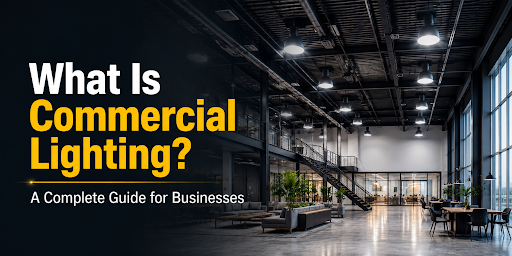
Lighting plays a major role in how a business space looks, performs, and feels. Whether it is a showroom, office, warehouse, factory, retail store, or indoor sports facility, the right lighting can improve visibility, safety, productivity, customer experience, and energy efficiency.
Commercial lighting refers to lighting systems designed specifically for business, industrial, retail, institutional, and large-format spaces. Unlike basic home lighting, commercial lighting must support long operating hours, larger areas, higher performance expectations, and different application needs.
For businesses planning a new project or upgrading an existing facility, choosing the right commercial led lighting solution is not only about brightness. It is about selecting lighting that delivers comfort, durability, energy savings, and long-term reliability.
At Tucana Lights, lighting is approached through research, design, engineering, and real-world application understanding. This guide explains what commercial lighting is, where it is used, how it works, and what businesses should consider before selecting a lighting solution.
What Is Commercial Lighting?
Commercial lighting is the use of professional lighting systems in spaces where business, industrial, retail, institutional, or public activities take place. These lighting systems are designed to provide proper illumination for work, movement, display, safety, and visual comfort.
Commercial lighting is commonly used in:
- Offices
- Showrooms
- Warehouses
- Factories
- Retail stores
- Shopping malls
- Indoor stadiums
- Auditoriums
- Convention centers
- Educational institutions
- Hospitals and healthcare spaces
- Parking areas
- Outdoor commercial spaces
- Logistics and storage facilities
The main purpose of commercial lighting is to create a safe, productive, efficient, and visually suitable environment for people using the space.
Good commercial lighting should support the function of the space. For example, a showroom needs lighting that enhances product presentation, while a warehouse needs uniform illumination for movement, picking, storage, and safety.
Commercial Lighting vs Residential Lighting
Commercial lighting is different from residential lighting because the usage conditions are different.
Residential lighting is usually designed for comfort, decoration, and limited daily usage. It is used in homes, apartments, bedrooms, kitchens, and living rooms.
Commercial lighting is designed for larger spaces, longer working hours, higher brightness requirements, and better durability. It must perform consistently in business environments where visibility, safety, and efficiency matter.
Key Differences
| Factor | Residential Lighting | Commercial Lighting |
| Usage | Homes and personal spaces | Business and professional spaces |
| Operating Hours | Limited daily use | Long and continuous use |
| Lighting Requirement | Comfort and ambience | Performance, safety, and visibility |
| Durability | Standard | Higher durability required |
| Maintenance | Easier replacement | Low maintenance preferred |
| Design Focus | Decorative and comfortable | Functional, efficient, and reliable |
Commercial spaces need lighting that is planned according to application. A warehouse, office, showroom, and indoor stadium cannot use the same lighting strategy.
Commercial Lighting vs Industrial Lighting
Commercial lighting and industrial lighting are closely connected, but they are not always the same.
Commercial lighting is a broad category used for business environments such as offices, retail stores, showrooms, malls, institutions, and commercial buildings.
Industrial lighting is more specific. It is used in factories, production plants, warehouses, manufacturing units, heavy engineering facilities, godowns, and logistics spaces.
Industrial lighting usually requires higher durability, stronger illumination, better thermal management, and long-term reliability because these environments can be more demanding.
For example, a premium showroom may need lighting with excellent visual appeal and product clarity. A manufacturing plant may need high-performance Factory Lights that provide strong, uniform illumination for safe and efficient work.
Both commercial and industrial lighting should be selected based on the real use of the space.
Common Types of Commercial Lighting
Different commercial spaces need different lighting solutions. The right product depends on ceiling height, area size, purpose, brightness requirement, design preference, and installation conditions.
Below are some common types of commercial lighting.
1. LED High Bay Lights
LED high bay lights are commonly used in spaces with high ceilings. These include warehouses, factories, production areas, indoor sports halls, and large industrial spaces.
High bay lights are designed to deliver strong illumination from greater heights. They are suitable for areas where regular lights may not provide enough brightness or coverage.
Businesses can explore products such as Highfin Light for spaces that require efficient high-bay lighting performance.
Best Used For:
- Warehouses
- Factories
- Logistics centers
- Industrial sheds
- Indoor stadiums
- Large workshops
- Storage facilities
2. Linear LED Lighting
Linear LED lighting is useful for spaces that require clean, uniform, and continuous illumination. It is often used in offices, classrooms, factories, retail spaces, workstations, and commercial interiors.
Linear lighting provides a modern look while supporting functional brightness.
Tucana’s Beamstream Series Lights are suitable for applications where sleek design, performance, and uniform illumination are important.
Best Used For:
- Offices
- Classrooms
- Workstations
- Retail spaces
- Printing areas
- Warehouses
- Commercial interiors
3. Bay Lights
Bay lights are suspended fixtures used in commercial, architectural, and industrial spaces. They provide functional illumination while also contributing to the appearance of the space.
These lights are useful when the lighting design must balance performance with aesthetics.
Businesses looking for suspended commercial lighting can explore Bay Light options for modern workspaces, showrooms, and architectural environments.
Best Used For:
- Commercial interiors
- Showrooms
- Offices
- Industrial spaces
- Architectural projects
- Public buildings
4. Parabolic Lights
Parabolic lights are designed for spaces where visual appeal and lighting performance need to work together. They are often used in architectural spaces, commercial interiors, design-led environments, and premium public areas.
These lighting solutions help create a refined look while maintaining practical illumination.
Explore Parabolic Lights for commercial environments where aesthetics and performance are both important.
Best Used For:
- Architectural spaces
- Premium interiors
- Commercial lobbies
- Hospitality areas
- Retail environments
- Public spaces
5. LED Flood Lights
LED flood lights are used for outdoor and large-area lighting. They provide powerful illumination for open spaces, building exteriors, parking areas, campuses, stadiums, and security applications.
Flood lights must be durable, energy-efficient, and capable of performing in outdoor conditions.
Best Used For:
- Parking areas
- Outdoor commercial spaces
- Industrial campuses
- Sports facilities
- Building exteriors
- Security lighting
- Logistics yards
Where Is Commercial Lighting Used?
Commercial lighting is used across many industries and environments. Each space has different lighting needs.
Offices
Office lighting should support focus, productivity, and visual comfort. Poor office lighting can cause eye strain, fatigue, and discomfort.
Good office lighting should provide balanced brightness without glare. It should support long working hours and create a comfortable indoor environment.
For office-related lighting applications, businesses can explore Office Lighting.
Showrooms
Showroom lighting must highlight products clearly and attractively. Whether it is an automobile showroom, furniture showroom, marble studio, garment showroom, or retail display area, lighting plays an important role in customer perception.
The right showroom lighting can improve product visibility, color appearance, depth, and overall ambience.
Businesses can explore Showroom Lights for application-focused solutions.
Warehouses and Logistics Centers
Warehouse lighting must be uniform, reliable, and practical. Workers need clear visibility for storage, movement, picking, loading, unloading, and safety.
Uneven lighting in warehouses can create dark zones and reduce operational efficiency.
Good warehouse lighting helps improve movement, inventory handling, and workplace safety.
Factories and Manufacturing Units
Factories need lighting that can handle long operating hours and demanding working conditions. Lighting must support productivity, safety, inspection accuracy, and machine operation. Different factory areas may require different lighting levels. Assembly lines, quality inspection areas, machine zones, storage sections, and loading areas all need proper planning.
For industrial applications, businesses can explore Factory Lights.
Architectural Spaces
Architectural spaces require lighting that supports both function and design. These spaces may include auditoriums, convention centers, institutions, public buildings, premium offices, and modern commercial interiors.
The lighting should blend with the design language of the space while still offering practical illumination.
Explore Architectural Spaces Lights for performance-driven and visually refined applications.
Indoor Sports Facilities
Sports lighting requires uniform brightness, visual comfort, and reduced glare. Indoor stadiums, badminton courts, sports halls, and recreational spaces need lighting that supports fast movement and clear visibility.
Poor sports lighting can affect player performance and viewer experience.
For sports-related applications, businesses can explore Sports Stadium Lights.
Benefits of LED Commercial Lighting
LED technology has become a preferred choice for commercial and industrial spaces because it offers performance, efficiency, and long-term value.
Here are the main benefits of LED commercial lighting.
1. Better Energy Efficiency
LED lights consume less energy compared to many traditional lighting systems. For businesses with large spaces and long operating hours, this can make a meaningful difference in electricity costs. Energy-efficient lighting also supports long-term operational savings.
2. Longer Operational Life
Commercial spaces need lighting that can perform consistently for years. LED fixtures generally offer longer operating life, which helps reduce replacement frequency and maintenance interruptions. For factories, warehouses, and commercial facilities, long life is an important factor.
3. Improved Brightness and Visibility
LED lighting provides strong and clear illumination. It can improve visibility in workplaces, showrooms, warehouses, and public spaces. Better visibility supports productivity, safety, and comfort.
4. Lower Maintenance Requirements
Frequent maintenance can disrupt business operations. This is especially true in high-ceiling spaces where replacing lights requires time, equipment, and labor. Reliable LED lighting helps reduce maintenance effort and operational inconvenience.
5. Better Design Flexibility
Modern commercial LED lights are available in different forms, beam angles, wattages, shapes, and designs. This allows businesses to select lighting that suits both technical and aesthetic requirements. Lighting can be planned according to the space instead of forcing one product into every application.
6. Better Visual Comfort
Good lighting should not create harsh glare or uncomfortable brightness. Properly designed LED lighting can improve visual comfort by offering balanced illumination, suitable beam spread, and better light distribution. This is especially important in offices, showrooms, sports spaces, and workplaces where people spend long hours.
Important Factors to Consider Before Choosing Commercial Lighting
Choosing commercial lighting requires planning. Businesses should evaluate technical, practical, and design-related factors before finalizing products.
1. Purpose of the Space
Start by understanding how the space is used. A warehouse, showroom, office, factory, and stadium all need different lighting solutions.
Ask these questions:
- What activity takes place in the space?
- How many hours will the lights operate daily?
- Is the area used for work, display, storage, movement, or public activity?
- Does the space need high brightness or visual comfort?
- Are there safety or inspection requirements?
The purpose of the space should guide the lighting selection.
2. Ceiling Height
Ceiling height affects the type of light, beam angle, and wattage required. High-ceiling areas usually need high bay lights or specialized industrial fixtures. Lower ceiling spaces may need linear lighting, bay lights, panels, or architectural lighting. Selecting the wrong light for the ceiling height can lead to poor brightness, glare, or uneven distribution.
3. Lux Requirement
Lux is the amount of light falling on a surface. Different spaces need different lux levels. For example, a storage area may need a different lux level than a quality inspection area. Similarly, a showroom may require lighting that improves product appearance, while a factory may need lighting that supports task accuracy. A professional lighting plan should consider lux requirements before product selection.
4. Beam Angle
Beam angle decides how light spreads from the fixture. A narrow beam focuses light in a smaller area, while a wider beam spreads light over a larger area. The right beam angle depends on height, spacing, and application. For high-ceiling spaces, beam angle is especially important.
5. Color Temperature
Color temperature affects the appearance and mood of a space. It is measured in Kelvin. Warm light creates a softer feel, while cool white light creates a brighter and more task-oriented environment. Commercial spaces often use neutral or cool white lighting depending on the application.
6. Color Rendering
Color rendering affects how accurately colors appear under a light source. This is important in showrooms, retail spaces, garment stores, marble studios, and display areas. If color appearance matters to your business, choose lighting with suitable color rendering performance.
7. Glare Control
Glare can reduce comfort and visibility. In offices, showrooms, factories, and sports facilities, glare can affect how people work and experience the space. Good lighting design should reduce harsh brightness and improve visual comfort.
8. Thermal Management
Commercial and industrial lights often operate for long hours. Heat management is important for maintaining performance and product life. Lighting fixtures with better thermal design can support durability and consistent operation.
9. Maintenance Access
Before selecting lights, consider how easily they can be maintained. High-ceiling areas, large warehouses, and industrial facilities may require special equipment for maintenance. Choosing long-lasting and reliable fixtures can reduce future maintenance challenges.
10. Aesthetic Design
Commercial lighting should not only perform well but also suit the appearance of the space. This is especially important in showrooms, offices, architectural spaces, retail stores, and public environments. The right lighting can improve both function and visual appeal.
How to Choose the Right Commercial Lighting Partner
Selecting a lighting product is important, but choosing the right lighting partner is equally important. A reliable lighting partner should understand your application, recommend suitable products, and provide technical guidance based on real site requirements. Before choosing a commercial lighting supplier, businesses should check:
- Product quality
- Application experience
- Technical knowledge
- Manufacturing capability
- Product durability
- Design approach
- Thermal performance
- Project support
- After-sales reliability
- Ability to support different environments
A lighting partner should not only sell fixtures. They should help you choose the right lighting system for your space.
Why Choose Tucana Lights for Commercial and Industrial Lighting?
Tucana Lights is a research and design-driven LED lighting manufacturer focused on high-performance lighting solutions for demanding environments.
The company designs and manufactures lighting solutions for factories, warehouses, offices, showrooms, indoor stadiums, architectural spaces, and other specialized applications.
Tucana’s approach combines engineering, research, thermal performance, reliability, and aesthetics. The focus is not only on illumination but also on improving how people work, move, and experience a space.
Businesses looking for a dependable LED lighting manufacturer can explore About Tucana to understand the company’s design, engineering, and manufacturing approach.
Commercial Lighting Checklist for Businesses
Before finalizing commercial lighting, use this checklist:
- Identify the exact application
- Measure the area and ceiling height
- Understand the required lux level
- Choose the right beam angle
- Consider operating hours
- Check energy efficiency
- Review thermal performance
- Evaluate glare and visual comfort
- Consider maintenance requirements
- Select lighting that suits the space design
- Work with an experienced lighting manufacturer
This approach helps businesses avoid common lighting mistakes and choose solutions that perform better over time.
Common Mistakes Businesses Make While Choosing Commercial Lighting
Many businesses choose lighting based only on wattage or price. This can lead to poor results.
Here are common mistakes to avoid:
Choosing Only by Wattage
Higher wattage does not always mean better lighting. Beam angle, lumens, height, and distribution also matter.
Ignoring Application Needs
Every space has a different lighting requirement. A showroom and a warehouse should not be treated the same way.
Not Considering Maintenance
Cheap lighting may lead to frequent replacement and higher long-term costs.
Overlooking Glare
Too much glare can reduce comfort and visibility, especially in offices, showrooms, and sports spaces.
Ignoring Thermal Performance
Poor heat management can affect product life and reliability.
Selecting Without Expert Guidance
Lighting selection should be based on technical understanding, not guesswork.
Final Thoughts
Commercial lighting is an important investment for any business. It affects safety, productivity, energy usage, customer experience, and the overall performance of a space.
The best lighting solution is not always the brightest or the cheapest. It is the one that matches the application, performs reliably, reduces energy waste, improves visibility, and supports long-term value.
Whether you are planning a factory, warehouse, showroom, office, indoor stadium, or architectural space, choosing the right commercial lighting partner can make a major difference.
Tucana Lights offers research-driven LED lighting solutions designed for performance, durability, visual comfort, and real-world application needs.
Looking for the right lighting solution for your business?
Contact Tucana Lights to discuss your commercial, industrial, or specialized lighting project.
FAQs About Commercial Lighting
What is commercial lighting?
Commercial lighting refers to lighting systems used in business, industrial, retail, institutional, and public spaces. It is designed to support visibility, safety, productivity, energy efficiency, and user comfort.
Where is commercial lighting used?
Commercial lighting is used in offices, showrooms, warehouses, factories, retail stores, malls, indoor stadiums, parking areas, institutions, and commercial buildings.
What is the difference between commercial and residential lighting?
Residential lighting is used in homes and focuses on comfort and ambience. Commercial lighting is designed for business spaces where performance, durability, brightness, efficiency, and long operating hours are important.
Why is LED lighting preferred for commercial spaces?
LED lighting is preferred because it offers better energy efficiency, longer life, stronger illumination, lower maintenance, and better design flexibility compared to many traditional lighting options.
How do I choose the right commercial lighting?
Start by understanding the space, ceiling height, required lux level, operating hours, beam angle, glare control, energy efficiency, and maintenance needs. It is also helpful to work with an experienced lighting manufacturer.
What type of lighting is best for warehouses?
Warehouses usually need high bay lights or industrial LED fixtures that provide uniform illumination, long life, energy efficiency, and strong visibility across large areas.
What type of lighting is best for showrooms?
Showrooms need lighting that improves product presentation, color appearance, customer experience, and visual appeal. The lighting should be bright, balanced, and suitable for the products being displayed.
Why should businesses invest in quality commercial lighting?
Quality commercial lighting can improve visibility, safety, productivity, energy savings, maintenance efficiency, and the overall experience of the space.