
Factory lighting plays a critical role in how efficiently and safely an industrial facility operates. From production floors and assembly lines to storage areas and inspection zones, every part of a factory depends on clear, reliable, and well-planned illumination.
Poor lighting can lead to reduced visibility, employee discomfort, lower productivity, and increased safety risks. On the other hand, the right lighting system can improve workflow, support precision work, reduce maintenance needs, and create a better working environment.
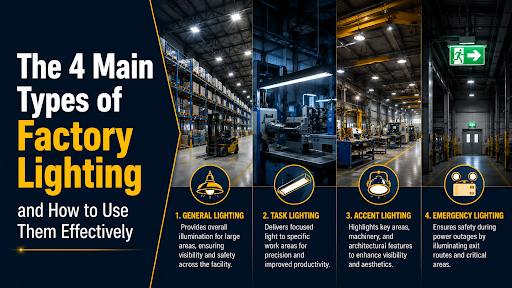
To design an effective factory lighting strategy, businesses must understand the main types of lighting used in industrial facilities and how each one supports different operational requirements.
Below are the four main types of factory lighting and how to use them effectively.
1. High Bay Lighting
High bay lighting is one of the most common lighting solutions used in factories with high ceilings and large open areas. These lights are designed to provide strong, uniform illumination from elevated mounting heights.
Best Used For:
Manufacturing floors
Industrial sheds
Assembly areas
Warehouses within factories
Large production halls
Why It Matters:
High bay lighting helps illuminate wide spaces evenly, making it easier for workers to move safely, operate machinery, and complete daily tasks. It is especially useful in factories where consistent visibility is required across large operational zones.
How to Use It Effectively:
High bay lights should be selected based on ceiling height, floor area, required illumination level, and the type of work being performed. Proper spacing and placement are important to avoid dark spots, excessive brightness, or uneven lighting.
2. Linear Lighting
Linear lighting is widely used in factories where long, continuous illumination is needed. These fixtures are especially useful in facilities with organized layouts, production lines, or workstations arranged in rows.
Best Used For:
Assembly lines
Packaging areas
Inspection zones
Production corridors
Workshop areas
Why It Matters:
Linear lighting provides smooth and consistent illumination across work areas. It helps reduce shadows and improves visibility for employees performing repetitive or detail-oriented tasks.
How to Use It Effectively:
Linear lights should be installed in alignment with work zones, machinery layouts, or movement paths. This helps ensure that light falls where it is needed most, improving both comfort and efficiency.
3. Task Lighting
Task lighting provides focused illumination for specific work areas where detailed visibility is required. While general factory lighting covers large spaces, task lighting supports precision-based operations.
Best Used For:
Quality inspection stations
Assembly benches
Machine maintenance areas
Testing zones
Detailed manufacturing tasks
Why It Matters:
Certain factory tasks require higher visual accuracy than general lighting can provide. Task lighting helps employees see details more clearly, reduce errors, and perform precision work with greater confidence.
How to Use It Effectively:
Task lighting should be positioned close to the work area without creating glare or harsh shadows. It should complement the main lighting system rather than replace it.
4. Flood Lighting
Flood lighting is commonly used for outdoor and large-area factory applications. These lights provide wide illumination coverage and are useful for areas that require visibility beyond the main indoor production space.
Best Used For:
Factory yards
Loading docks
Parking areas
Outdoor storage spaces
Security zones
Entry and exit points
Why It Matters:
Factory operations often extend beyond indoor spaces. Proper outdoor lighting improves safety, supports vehicle movement, enhances security, and helps maintain smooth operations during evening or night shifts.
How to Use It Effectively:
Flood lights should be positioned to provide wide coverage without creating glare for workers, drivers, or nearby areas. Weather resistance, mounting height, beam angle, and durability should be considered before selection.
How to Choose the Right Factory Lighting Combination
Most factories require more than one type of lighting. A successful lighting plan combines different solutions based on how each area of the facility is used.
Before choosing factory lighting, consider:
Ceiling height
Type of work performed
Operating hours
Machinery layout
Employee movement areas
Maintenance access
Safety requirements
Energy efficiency goals
Using the same lighting across the entire facility may not deliver the best results. Production areas, inspection stations, storage zones, and outdoor spaces all require different lighting approaches.
Common Mistakes to Avoid
Factory lighting projects often underperform because of avoidable planning mistakes.
Some common mistakes include:
Selecting lights based only on price
Focusing only on brightness instead of visibility
Ignoring glare and shadow control
Using the same fixtures for every area
Overlooking maintenance requirements
Not considering long-term energy costs
A well-planned factory lighting system should support safety, productivity, comfort, and long-term operational efficiency.
Conclusion
Factory lighting is not just about installing bright fixtures. It is about creating a lighting system that supports how the facility actually works.
High bay lighting, linear lighting, task lighting, and flood lighting each play an important role in improving visibility, safety, and productivity across different factory environments. When used correctly, these solutions help create industrial spaces that are more efficient, reliable, and comfortable for employees.
At Tucana Lights, we develop research and design-driven lighting solutions for factories, warehouses, industrial buildings, and specialized commercial environments. Our focus is on creating lighting systems that deliver dependable performance, long-term reliability, and better working conditions.
Choosing the right factory lighting today can help businesses build safer, more productive, and more efficient industrial facilities for the future.